
Pipeline
Strike is building a pipeline of first in class in vivo CAR-M candidates for autoimmune disease and cancer, as well as a next generation in vivo CAR-T program that is developed in collaboration with AbClon Inc. under a Eurostars grant.

LNP-based in vivo CAR therapy constitutes an off-the-shelf alternative to autologous CAR therapies, such as the approved CAR-T treatments. It holds the potential to be equally effective without the need for lengthy and costly personalized production and without the need for chemotherapy-induced lymphodepletion. Moreover, the effect is transient, which reduces potential safety concerns and allows for repeated administration and titration of its pharmacodynamic effects. Our LNP-based platform enables selective delivery to defined immune cell populations with low risk of immunogenicity while the site-directed affinity conjugation removes the need for post-conjugation purification and increases potency and efficacy.
In vivo CAR-M for T cell dependent inflammatory disease
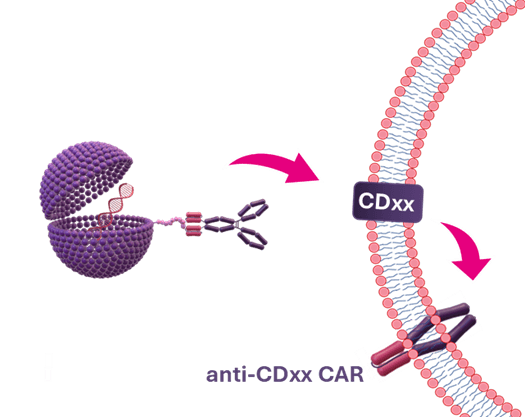
Strike develops a first in class in vivo CAR-M therapy based on targeted LNPs that deliver CAR mRNA to circulating monocytes. In vivo CAR-Ms are associated with a number of potential advantages compared to in vivo CAR-Ts, including a lower risk of toxicity, its natural homing to inflamed tissues and superior tissue infiltration. Moreover, CAR-Ms can deplete autoreactive T cells without risk of fratricide, whereas a T cell-targeting CAR-T would deplete other CAR-Ts. Upon LNP uptake, the monocyte will start to express the CAR on its cell membrane and soon leave the blood stream and home into inflamed tissues. Once there, it is transformed into a macrophage with targeted phagocytic properties. Specifically, the program aims at generating CAR-Ms that target autoreactive T cells for treatment of T-cell dependent autoimmunity and inflammatory disease, including the potential to induce a local immune reset. Indications may e.g. include severe treatment-refractory asthma, psoriatic arthritis, myositis with ILD, or checkpoint-induced colitis. Strike focus on targeted LNP delivery to monocytes, rather than making use of un-targeted naked LNPs. While monocytes and macrophages are natural phagocytes and can be transiently reprogrammed using naked LNPs, our targeting technology increases uptake and expression by an order of magnitude, thus increasing efficacy and reducing the risk for off-target toxicity compared to un-targeted approaches.
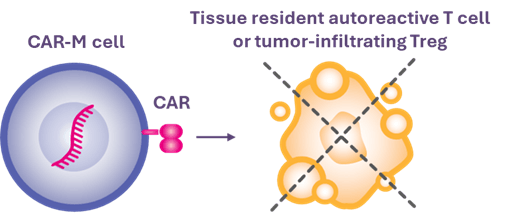
The CAR-M cell distributes into inflamed tissues and attacks autoreactive T-cell or regulatory T cells.
In vivo CAR-M for depletion of regulatory T cells in cancer
A second discovery stage in vivo CAR-M program targets tumor-infiltrating regulatory T cells and aims at augmenting the effect of cancer immunotherapies for the treatment of solid tumors.
In vivo CAR-T for autoimmune disease and cancer
StAb19 is a second-generation B-cell targeting in vivo CAR-T developed in collaboration with AbClon Inc under a Eurostars grant. It is based on a T cell-targeting antibody and a novel CD19 CAR binding to a unique epitope and that has been optimized for fast off-rate to prolong CAR-T activation. The CD19 CAR mRNA is thus delivered to T cells that are subsequently reprogrammed to in vivo CAR-Ts targeting B-cells. The candidate is intended for treatment of B-cell dependent autoimmune disease and B-cell malignancies.